

Build a Price-Triggered ETH Escrow
This tutorial builds an escrow contract that locks ETH and releases it to a recipient when ETH/USD crosses a price threshold, using the Stork pull oracle for on-chain price data.
You'll write the contract, test it against a mock oracle, deploy it to testnet or mainnet, and build a server-side-safe Next.js frontend with Wagmi.
Architecture Context
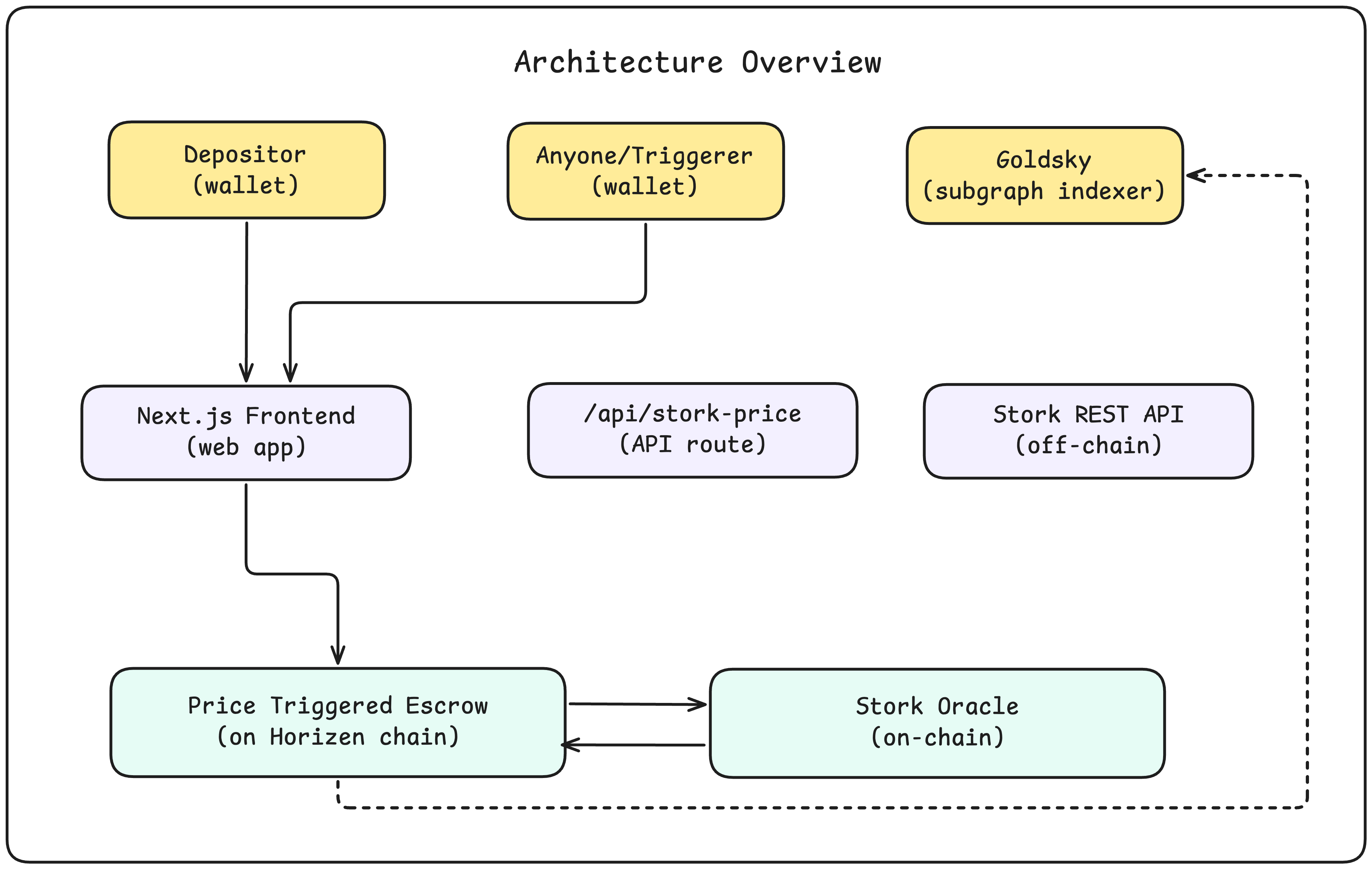
Two concepts govern this dApp's design.
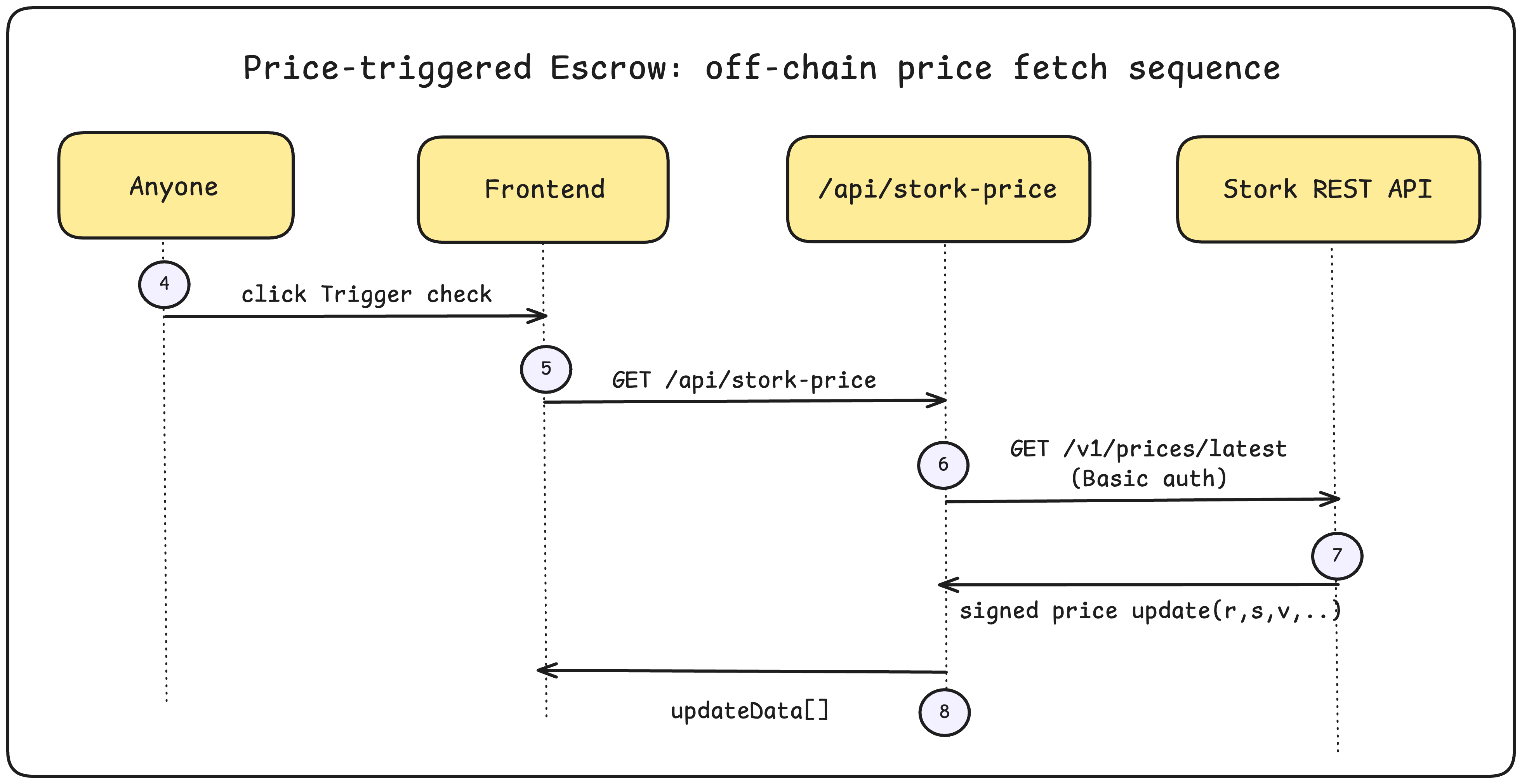
Pull oracle model. Stork does not push prices on-chain automatically. Instead, callers fetch a signed price payload from the Stork REST API off-chain and include it as calldata in the transaction that needs the price. The contract passes that payload to stork.updateTemporalNumericValuesV1(), which verifies the publisher's ECDSA signature and writes the price. The contract then reads it back with stork.getTemporalNumericValueV1(). This means anyone can trigger the release, because anyone can fetch a fresh price and submit it.
Fee model. Horizen L3 has two fee components:
- L2 execution fee - gas used × base fee
- L1 data fee - calldata batch cost, appended automatically by the OP Stack
The Stork oracle itself also charges a small per-update fee (singleUpdateFeeInWei, query getUpdateFeeV1 at runtime). On testnet this is 1 wei. Your triggerCheck call must forward at least that amount via msg.value.
Network Reference
For RPC endpoints, chain IDs, explorer, and faucet:
Step 1: Define the Stork Interface
Stork's on-chain contract is deployed at 0xacC0a0cF13571d30B4b8637996F5D6D774d4fd62 on both Horizen testnet and mainnet.
// SPDX-License-Identifier: MIT
pragma solidity ^0.8.24;

interface IStork {
    struct TemporalNumericValue {
        uint64 timestampNs;
        int192 quantizedValue; // price scaled by 1e18
    }

    struct TemporalNumericValueInput {
        TemporalNumericValue temporalNumericValue;
        bytes32 id;
        bytes32 publisherMerkleRoot;
        bytes32 valueComputeAlgHash;
        bytes32 r;
        bytes32 s;
        uint8 v;
    }

    function updateTemporalNumericValuesV1(
        TemporalNumericValueInput[] calldata updateData
    ) external payable;

    function getUpdateFeeV1(
        TemporalNumericValueInput[] calldata updateData
    ) external view returns (uint256 feeAmount);

    function getTemporalNumericValueV1(bytes32 id)
        external view returns (TemporalNumericValue memory value);
}
Key facts about the Stork data model:
quantizedValueisint192scaled to 18 decimals. Example: $3,500 is3500e18.timestampNsis a nanosecond Unix timestamp (uint64). It's a 19-digit integer that exceeds float64 precision. See Step 5 for why this matters in JavaScript.- The ETH/USD asset ID on all networks:
0x59102b37de83bdda9f38ac8254e596f0d9ac61d2035c07936675e87342817160— derived as keccak256("ETHUSD"); verify withcast keccak "ETHUSD"
Step 2: Write the Contract
// src/TriggerVault.sol
// SPDX-License-Identifier: MIT
pragma solidity ^0.8.24;

contract TriggerVault {
    bytes32 public constant ETH_USD_ID =
        0x59102b37de83bdda9f38ac8254e596f0d9ac61d2035c07936675e87342817160;

    IStork public immutable stork;

    enum Direction { Above, Below }

    struct Escrow {
        address depositor;
        address recipient;
        uint256 amount;
        int256 targetPrice; // USD, 18 decimals
        Direction direction;
        bool active;
    }

    uint256 public nextId;
    mapping(uint256 => Escrow) public escrows;

    event EscrowCreated(uint256 indexed id, address indexed depositor,
        address indexed recipient, uint256 amount, int256 targetPrice, Direction direction);
    event EscrowReleased(uint256 indexed id, address indexed recipient,
        uint256 amount, int256 triggerPrice);
    event EscrowCancelled(uint256 indexed id, address indexed depositor, uint256 amount);

    error NotDepositor();
    error EscrowNotActive();
    error ConditionNotMet();
    error TransferFailed();
    error ZeroAmount();
    error ZeroAddress();

    constructor(address _stork) {
        stork = IStork(_stork);
    }

    function createEscrow(
        address recipient,
        int256 targetPrice,
        Direction direction
    ) external payable returns (uint256 id) {
        if (msg.value == 0) revert ZeroAmount();
        if (recipient == address(0)) revert ZeroAddress();

        id = nextId++;
        escrows[id] = Escrow({
            depositor: msg.sender,
            recipient: recipient,
            amount: msg.value,
            targetPrice: targetPrice,
            direction: direction,
            active: true
        });

        emit EscrowCreated(id, msg.sender, recipient, msg.value, targetPrice, direction);
    }

    /// @notice Push a fresh Stork price on-chain and release ETH if the condition is met.
    /// @param updateData Signed payload from GET /v1/prices/latest?assets=ETHUSD
    /// @dev msg.value must cover the Stork update fee (query getUpdateFeeV1; 1 wei on testnet).
    function triggerCheck(
        uint256 id,
        IStork.TemporalNumericValueInput[] calldata updateData
    ) external payable {
        Escrow storage e = escrows[id];
        if (!e.active) revert EscrowNotActive();

        stork.updateTemporalNumericValuesV1{value: msg.value}(updateData);

        IStork.TemporalNumericValue memory tv = stork.getTemporalNumericValueV1(ETH_USD_ID);
        int256 currentPrice = int256(tv.quantizedValue);

        bool conditionMet = e.direction == Direction.Above
            ? currentPrice >= e.targetPrice
            : currentPrice <= e.targetPrice;

        if (!conditionMet) revert ConditionNotMet();

        e.active = false;
        uint256 amount = e.amount;
        emit EscrowReleased(id, e.recipient, amount, currentPrice);

        (bool ok,) = e.recipient.call{value: amount}("");
        if (!ok) revert TransferFailed();
    }

    function cancelEscrow(uint256 id) external {
        Escrow storage e = escrows[id];
        if (!e.active) revert EscrowNotActive();
        if (e.depositor != msg.sender) revert NotDepositor();

        e.active = false;
        uint256 amount = e.amount;
        emit EscrowCancelled(id, msg.sender, amount);

        (bool ok,) = msg.sender.call{value: amount}("");
        if (!ok) revert TransferFailed();
    }

    function getEscrowsByDepositor(address depositor)
        external view returns (uint256[] memory ids)
    {
        uint256 count;
        for (uint256 i = 0; i < nextId; i++) {
            if (escrows[i].depositor == depositor) count++;
        }
        ids = new uint256[](count);
        uint256 j;
        for (uint256 i = 0; i < nextId; i++) {
            if (escrows[i].depositor == depositor) ids[j++] = i;
        }
    }
}
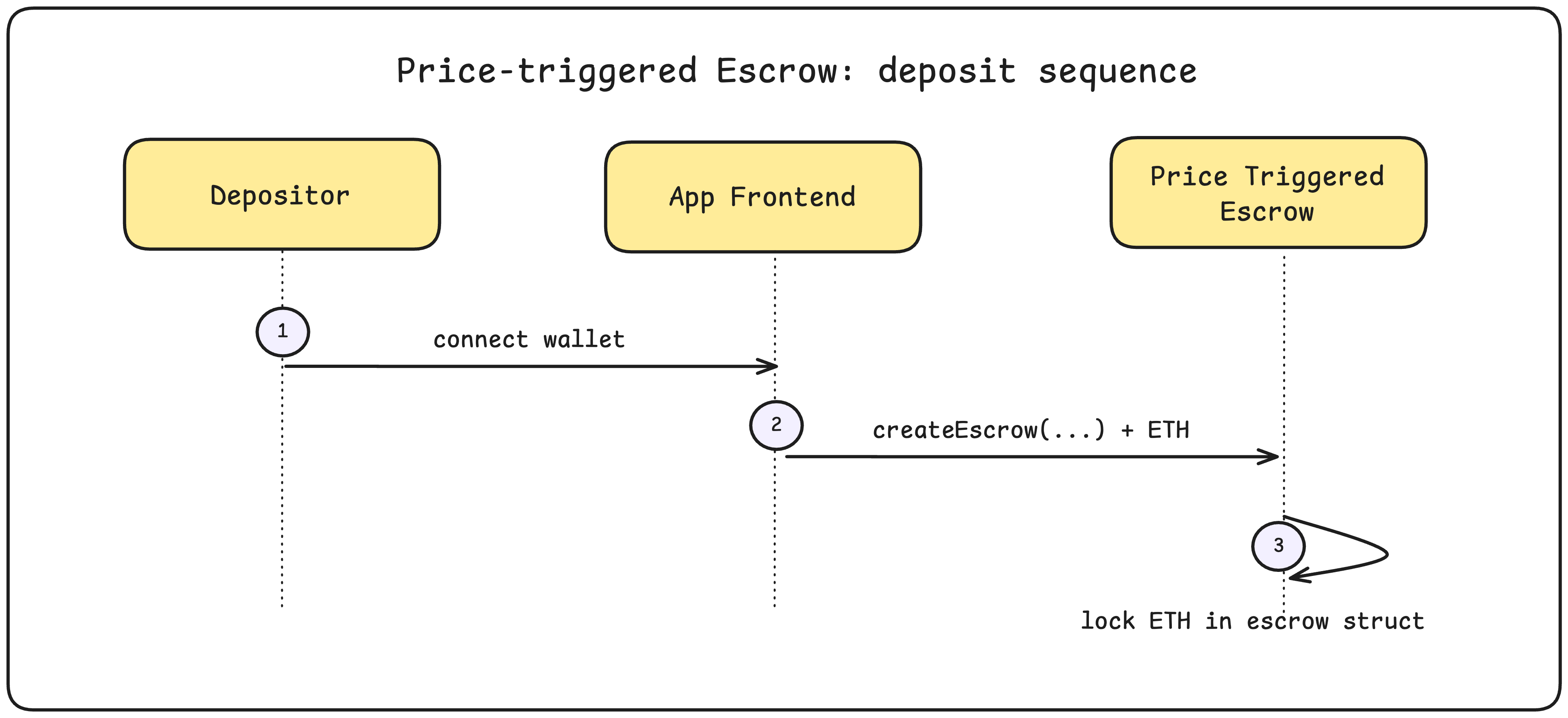
Design decisions worth noting:
triggerCheckis permissionless so any account can call it. ETH always goes toe.recipient, not to the caller, so there's no griefing risk from third-party triggering.msg.valueis forwarded directly toupdateTemporalNumericValuesV1. Do not hardcode 0 because the Stork fee is a runtime value and may change.- ETH transfer uses a low-level
callrather thantransferto avoid gas-limit issues with contract recipients.
Step 3: Test Locally with MockStork
Foundry tests should never hit a live oracle. Use a minimal mock that implements the same interface.
// test/TriggerVault.t.sol
// SPDX-License-Identifier: MIT
pragma solidity ^0.8.24;

import {Test} from "forge-std/Test.sol";
import {TriggerVault, IStork} from "../src/TriggerVault.sol";

contract MockStork {
    int192 public price;

    function setPrice(int192 _price) external { price = _price; }

    function updateTemporalNumericValuesV1(
        IStork.TemporalNumericValueInput[] calldata
    ) external payable {}

    function getUpdateFeeV1(
        IStork.TemporalNumericValueInput[] calldata
    ) external pure returns (uint256) { return 0; }

    function getTemporalNumericValueV1(bytes32)
        external view returns (IStork.TemporalNumericValue memory)
    {
        return IStork.TemporalNumericValue({
            timestampNs: uint64(block.timestamp * 1e9),
            quantizedValue: price
        });
    }
}

contract TriggerVaultTest is Test {
    TriggerVault vault;
    MockStork stork;

    address depositor = makeAddr("depositor");
    address recipient = makeAddr("recipient");
    int256 constant TARGET = 3500e18;

    function setUp() public {
        stork = new MockStork();
        vault = new TriggerVault(address(stork));
        vm.deal(depositor, 10 ether);
    }

    function test_triggerReleasesWhenConditionMet() public {
        vm.prank(depositor);
        uint256 id = vault.createEscrow{value: 1 ether}(
            recipient, TARGET, TriggerVault.Direction.Above
        );

        stork.setPrice(int192(3600e18));
        vault.triggerCheck(id, new IStork.TemporalNumericValueInput[](0));

        (,,,,,bool active) = vault.escrows(id);
        assertFalse(active);
        assertEq(recipient.balance, 1 ether);
    }

    function test_triggerRevertsWhenConditionNotMet() public {
        vm.prank(depositor);
        uint256 id = vault.createEscrow{value: 1 ether}(
            recipient, TARGET, TriggerVault.Direction.Above
        );

        stork.setPrice(int192(3000e18));
        vm.expectRevert(TriggerVault.ConditionNotMet.selector);
        vault.triggerCheck(id, new IStork.TemporalNumericValueInput[](0));
    }

    function test_cancelReturnsETH() public {
        vm.prank(depositor);
        uint256 id = vault.createEscrow{value: 1 ether}(recipient, TARGET, TriggerVault.Direction.Above);

        vm.prank(depositor);
        vault.cancelEscrow(id);

        assertEq(depositor.balance, 10 ether);
    }

    function test_cancelRevertsForNonDepositor() public {
        vm.prank(depositor);
        uint256 id = vault.createEscrow{value: 1 ether}(recipient, TARGET, TriggerVault.Direction.Above);

        vm.expectRevert(TriggerVault.NotDepositor.selector);
        vault.cancelEscrow(id);
    }
}
Run the suite:
forge test -vvv
Don't deploy until all tests pass. Gas costs ETH on testnet but a broken oracle integration costs more.
Step 4: Deploy
Write a deploy script so private keys never appear on the command line.
// script/Deploy.s.sol
// SPDX-License-Identifier: MIT
pragma solidity ^0.8.24;

import {Script, console} from "forge-std/Script.sol";
import {TriggerVault} from "../src/TriggerVault.sol";

contract DeployScript is Script {
    // Stork oracle — same address on Horizen testnet and mainnet
    address constant STORK = 0xacC0a0cF13571d30B4b8637996F5D6D774d4fd62;

    function run() external {
        uint256 pk = vm.envUint("PRIVATE_KEY");
        vm.startBroadcast(pk);

        TriggerVault vault = new TriggerVault(STORK);
        console.log("TriggerVault deployed at:", address(vault));

        vm.stopBroadcast();
    }
}
Add both Horizen RPC aliases to foundry.toml:
[rpc_endpoints]
horizen_testnet = "https://horizen-testnet.rpc.caldera.xyz/http"
horizen_mainnet = "https://horizen.calderachain.xyz/http"
Deploy to testnet:
forge script script/Deploy.s.sol:DeployScript \
  --rpc-url horizen_testnet \
  --broadcast \
  --private-key $PRIVATE_KEY
Deploy to mainnet:
forge script script/Deploy.s.sol:DeployScript \
  --rpc-url horizen_mainnet \
  --broadcast \
  --private-key $PRIVATE_KEY
Save the printed address. You'll set it as NEXT_PUBLIC_CONTRACT_ADDRESS in your frontend.
Step 5: Server-Side Price Proxy
The Stork REST API requires an API key. Never expose it client-side. Use a Next.js API route as a server-side proxy.
// app/api/stork-price/route.ts
import { NextResponse } from "next/server";

const STORK_API = "https://rest.jp.stork-oracle.network/v1/prices/latest";
const ETH_USD_ASSET = "ETHUSD";

export async function GET() {
  const apiKey = process.env.STORK_API_KEY;
  if (!apiKey) {
    return NextResponse.json({ error: "STORK_API_KEY not set" }, { status: 500 });
  }

  const res = await fetch(`${STORK_API}?assets=${ETH_USD_ASSET}`, {
    headers: { Authorization: `Basic ${apiKey}` },
    cache: "no-store",
  });

  if (!res.ok) {
    return NextResponse.json({ error: `Stork API error: ${res.status}` }, { status: res.status });
  }

  // IMPORTANT: use res.text() + regex, not res.json().
  // timestampNs is a 19-digit integer. JavaScript's JSON.parse converts it to
  // float64, silently rounding it by up to 215ns. The Stork oracle's ECDSA
  // signature is computed over the exact integer — a rounded value produces
  // a hash mismatch and the oracle reverts with InvalidSignature (0x8baa579f).
  const rawText = await res.text();
  const safeText = rawText.replace(/:(\s*)(-?\d{16,})([,}\]])/g, `:$1"$2"$3`);
  const body = JSON.parse(safeText);

  const entry = body?.data?.[ETH_USD_ASSET];
  if (!entry) {
    return NextResponse.json({ error: "No ETHUSD data in response" }, { status: 502 });
  }

  const sp = entry.stork_signed_price;

  const updateData = [{
    temporalNumericValue: {
      timestampNs: sp.timestamped_signature.timestamp,   // string — preserved precision
      quantizedValue: sp.price,                          // string — preserved precision
    },
    id: sp.encoded_asset_id as `0x${string}`,
    publisherMerkleRoot: sp.publisher_merkle_root as `0x${string}`,
    valueComputeAlgHash: (sp.calculation_alg.checksum.startsWith("0x")
      ? sp.calculation_alg.checksum
      : `0x${sp.calculation_alg.checksum}`) as `0x${string}`,
    r: sp.timestamped_signature.signature.r as `0x${string}`,
    s: sp.timestamped_signature.signature.s as `0x${string}`,
    v: Number(sp.timestamped_signature.signature.v),
  }];

  return NextResponse.json({ updateData });
}
The precision requirement is non-negotiable: timestampNs and quantizedValue must survive JSON serialisation as strings and be converted to BigInt on the frontend. Passing rounded integers into updateTemporalNumericValuesV1 causes InvalidSignature. The oracle hashes these exact values before recovering the publisher's signing address.
Step 6: Frontend Integration
Create src/lib/contract.ts with the addresses for your target network:
// src/lib/contract.ts
export const TRIGGER_VAULT_ADDRESS = process.env
  .NEXT_PUBLIC_CONTRACT_ADDRESS as `0x${string}`;

// Same on testnet and mainnet
export const STORK_ADDRESS =
  "0xacC0a0cF13571d30B4b8637996F5D6D774d4fd62" as const;
Creating an escrow
import { useWriteContract } from "wagmi";
import { parseEther } from "viem";
import { triggerVaultAbi } from "@/lib/abi";
import { TRIGGER_VAULT_ADDRESS } from "@/lib/contract";

const { writeContractAsync } = useWriteContract();

async function handleCreate(
  recipient: `0x${string}`,
  targetPriceUsd: number,   // e.g. 3500
  direction: 0 | 1          // 0 = Above, 1 = Below
) {
  await writeContractAsync({
    address: TRIGGER_VAULT_ADDRESS,
    abi: triggerVaultAbi,
    functionName: "createEscrow",
    args: [
      recipient,
      BigInt(Math.round(targetPriceUsd * 1e18)), // scale to 18 decimals
      direction,
    ],
    value: parseEther("0.01"), // ETH to lock in the escrow
  });
}
Reading escrows
import { useReadContract } from "wagmi";
import { triggerVaultAbi } from "@/lib/abi";
import { TRIGGER_VAULT_ADDRESS } from "@/lib/contract";

const { data: escrowIds } = useReadContract({
  address: TRIGGER_VAULT_ADDRESS,
  abi: triggerVaultAbi,
  functionName: "getEscrowsByDepositor",
  args: [address],
});
Triggering an escrow
Fetch the signed price, simulate the call to surface revert reasons early, then send it.
import { useAccount, useWriteContract, usePublicClient } from "wagmi";
import { triggerVaultAbi, storkAbi } from "@/lib/abi";
import { TRIGGER_VAULT_ADDRESS, STORK_ADDRESS } from "@/lib/contract";

// Shape of each item returned by /api/stork-price
interface UpdateDataRaw {
  temporalNumericValue: { timestampNs: string; quantizedValue: string };
  id: `0x${string}`;
  publisherMerkleRoot: `0x${string}`;
  valueComputeAlgHash: `0x${string}`;
  r: `0x${string}`;
  s: `0x${string}`;
  v: number;
}

const { address } = useAccount();
const { writeContractAsync } = useWriteContract();
const publicClient = usePublicClient();

async function handleTrigger(escrowId: bigint) {
  const res = await fetch("/api/stork-price");
  const { updateData } = await res.json();

  // Convert string fields to BigInt before passing to viem
  const updateDataTyped = (updateData as UpdateDataRaw[]).map((d) => ({
    ...d,
    temporalNumericValue: {
      timestampNs: BigInt(d.temporalNumericValue.timestampNs),
      quantizedValue: BigInt(d.temporalNumericValue.quantizedValue),
    },
  }));

  // Query the required Stork fee at runtime — do not hardcode
  const storkFee = await publicClient!.readContract({
    address: STORK_ADDRESS,
    abi: storkAbi,
    functionName: "getUpdateFeeV1",
    args: [updateDataTyped],
  }) as bigint;

  const callParams = {
    address: TRIGGER_VAULT_ADDRESS,
    abi: triggerVaultAbi,
    functionName: "triggerCheck" as const,
    args: [escrowId, updateDataTyped] as const,
    value: storkFee,
  };

  // Simulate first — surfaces ConditionNotMet, InvalidSignature, InsufficientFee
  // as readable errors before the wallet popup
  if (publicClient && address) {
    await publicClient.simulateContract({ ...callParams, account: address });
  }

  await writeContractAsync(callParams);
}
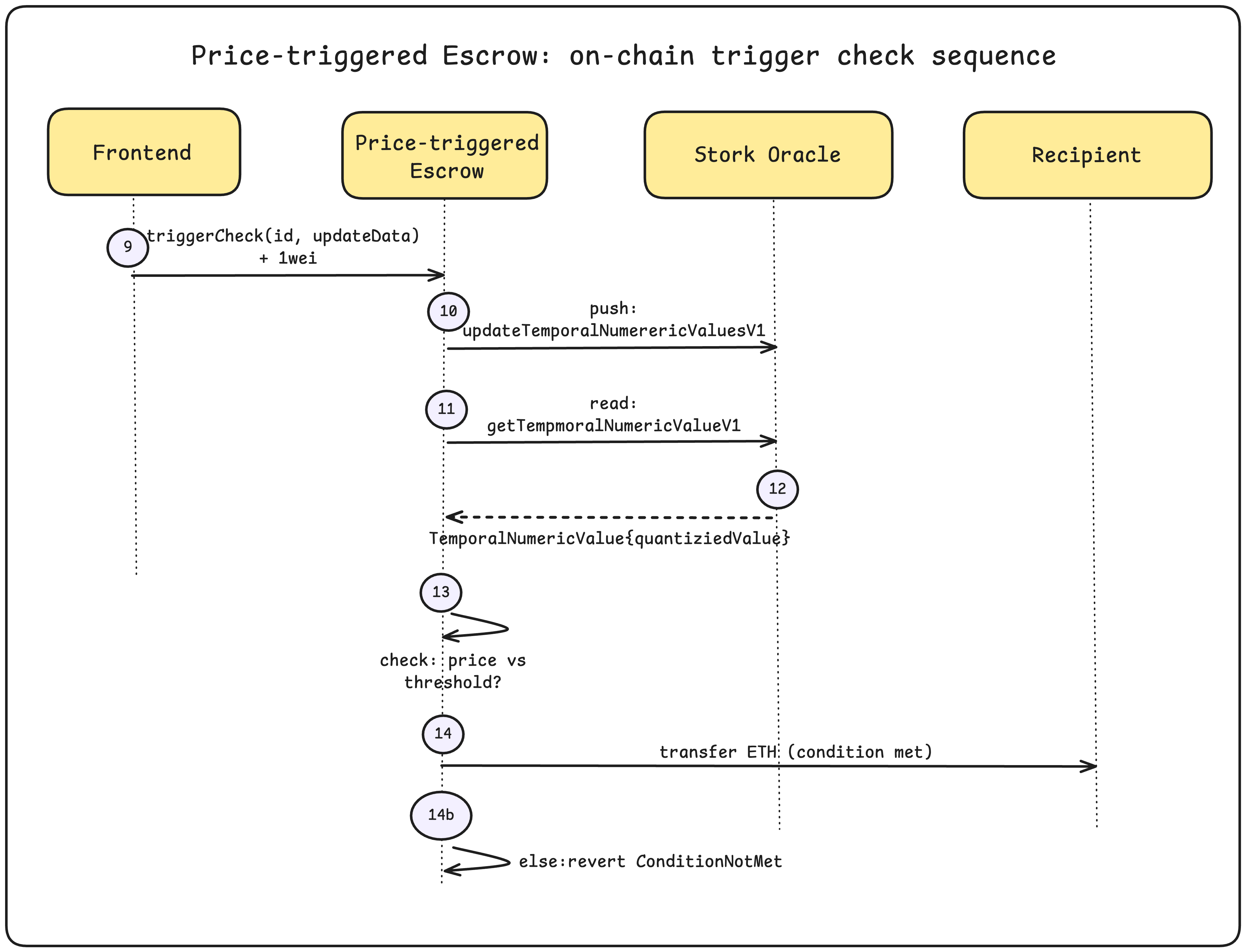
Three things to get right in the trigger call:
value: storkFee- must forward at leastgetUpdateFeeV1()wei to the Stork oracle. The snippet above queries it at runtime before the call; passing 0 reverts withInsufficientFee (0x025dbdd4).- BigInt conversion -
timestampNsandquantizedValuecome back from the API route as strings. Convert them withBigInt()before passing to viem; viem encodes them asuint64andint192respectively. simulateContractbeforewriteContractAsync- catchesConditionNotMetand oracle errors before the wallet confirmation dialog, giving the user a readable error instead of a failed transaction.
ABI reference
Create src/lib/abi.ts. The struct components for updateData must match the Solidity interface defined in Step 1 exactly as triggerCheck and getUpdateFeeV1 both take the same TemporalNumericValueInput[].
// src/lib/abi.ts

// Shared struct components for TemporalNumericValueInput
const updateDataComponents = [
  {
    name: "temporalNumericValue",
    type: "tuple",
    components: [
      { name: "timestampNs", type: "uint64" },
      { name: "quantizedValue", type: "int192" },
    ],
  },
  { name: "id", type: "bytes32" },
  { name: "publisherMerkleRoot", type: "bytes32" },
  { name: "valueComputeAlgHash", type: "bytes32" },
  { name: "r", type: "bytes32" },
  { name: "s", type: "bytes32" },
  { name: "v", type: "uint8" },
] as const;

export const triggerVaultAbi = [
  {
    name: "createEscrow",
    type: "function",
    inputs: [
      { name: "recipient", type: "address" },
      { name: "targetPrice", type: "int256" },
      { name: "direction", type: "uint8" }, // 0 = Above, 1 = Below
    ],
    outputs: [{ name: "id", type: "uint256" }],
    stateMutability: "payable",
  },
  {
    name: "triggerCheck",
    type: "function",
    inputs: [
      { name: "id", type: "uint256" },
      { name: "updateData", type: "tuple[]", components: updateDataComponents },
    ],
    outputs: [],
    stateMutability: "payable",
  },
  {
    name: "cancelEscrow",
    type: "function",
    inputs: [{ name: "id", type: "uint256" }],
    outputs: [],
    stateMutability: "nonpayable",
  },
  {
    name: "getEscrowsByDepositor",
    type: "function",
    inputs: [{ name: "depositor", type: "address" }],
    outputs: [{ name: "ids", type: "uint256[]" }],
    stateMutability: "view",
  },
] as const;

export const storkAbi = [
  {
    name: "getUpdateFeeV1",
    type: "function",
    inputs: [
      { name: "updateData", type: "tuple[]", components: updateDataComponents },
    ],
    outputs: [{ name: "feeAmount", type: "uint256" }],
    stateMutability: "view",
  },
] as const;
Step 7: Verify on the Explorer
Testnet:
forge verify-contract $DEPLOYED_ADDRESS src/TriggerVault.sol:TriggerVault \
  --rpc-url https://horizen-testnet.rpc.caldera.xyz/http \
  --constructor-args $(cast abi-encode "constructor(address)" $STORK_ADDRESS)
Mainnet:
forge verify-contract $DEPLOYED_ADDRESS src/TriggerVault.sol:TriggerVault \
  --rpc-url https://horizen.calderachain.xyz/http \
  --constructor-args $(cast abi-encode "constructor(address)" $STORK_ADDRESS)
Horizen's explorer is powered by Blockscout. If verification doesn't auto-detect the verifier, it accepts any non-empty API key; add a customChains entry to your Hardhat config if using that path.
Interacting On-Chain (cast)
Set your RPC URL for the target network first:
# Testnet
export RPC_URL=https://horizen-testnet.rpc.caldera.xyz/http

# Mainnet
export RPC_URL=https://horizen.calderachain.xyz/http
export STORK=0xacC0a0cF13571d30B4b8637996F5D6D774d4fd62
export ETH_USD_ID=0x59102b37de83bdda9f38ac8254e596f0d9ac61d2035c07936675e87342817160

# Read the latest ETH/USD price from the Stork oracle
cast call $STORK "getTemporalNumericValueV1(bytes32)(uint64,int192)" $ETH_USD_ID \
  --rpc-url $RPC_URL

# Read a specific escrow
cast call $VAULT "escrows(uint256)(address,address,uint256,int256,uint8,bool)" 0 \
  --rpc-url $RPC_URL

# Cancel an escrow (depositor only)
cast send $VAULT "cancelEscrow(uint256)" 0 \
  --rpc-url $RPC_URL \
  --private-key $PRIVATE_KEY
Event Indexing
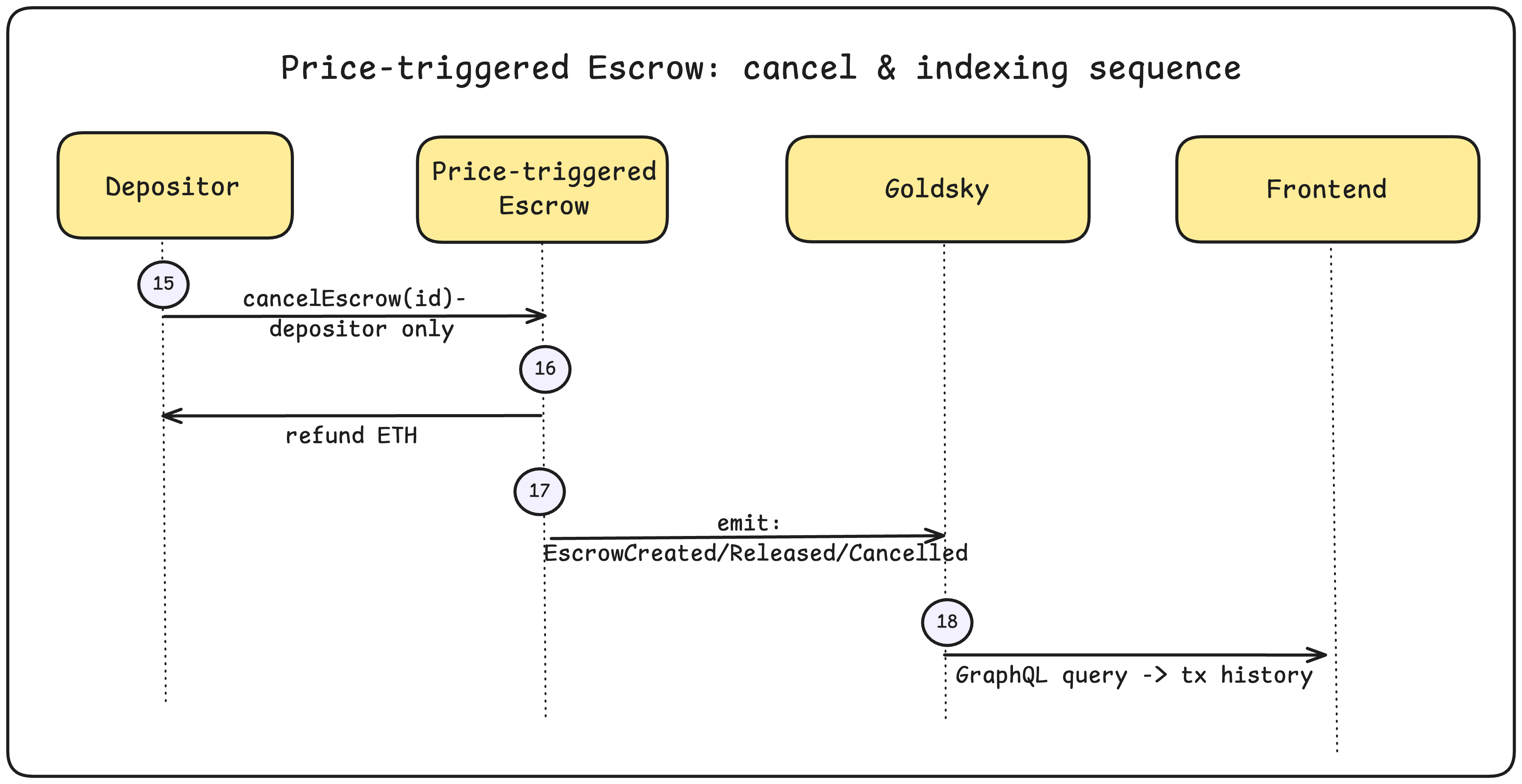
The contract emits three events suitable for indexing with Goldsky or any subgraph-compatible pipeline:
| Event | Fields |
|---|---|
EscrowCreated | id, depositor, recipient, amount, targetPrice, direction |
EscrowReleased | id, recipient, amount, triggerPrice |
EscrowCancelled | id, depositor, amount |
All three are indexed with id as the primary key, making historical queries efficient without a full table scan.